

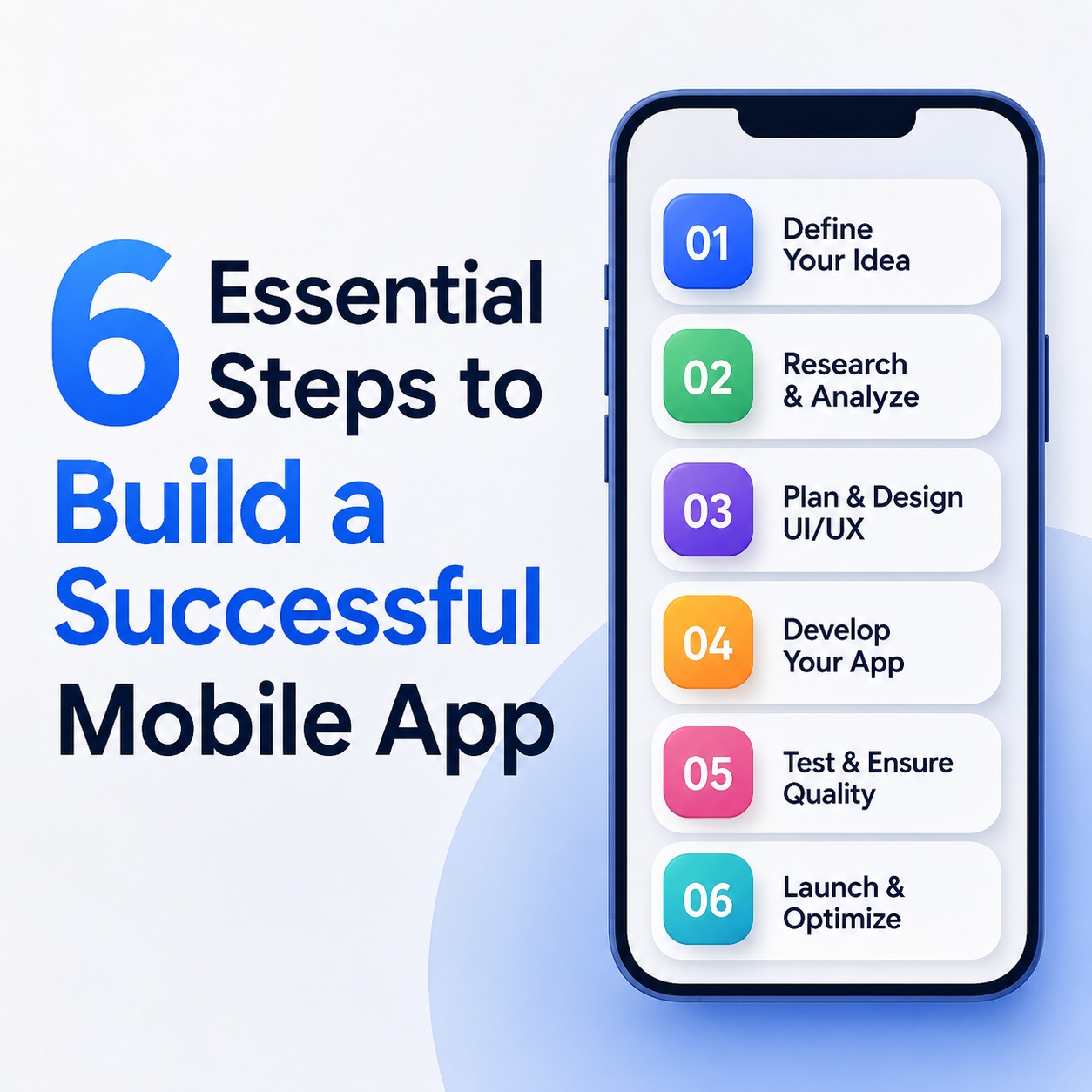
6 Essential Steps to Build a Successful Mobile App: The Complete Mobile App Development Guide for 2026
Building a mobile app can feel overwhelming, especially when competition is higher than ever. Successful Mobile App Development requires more than a great idea, it demands strategic planning, user-focused design, the right technology, and ongoing optimization. Whether you’re launching a startup or expanding an existing business, understanding the development process can help you avoid costly mistakes, improve user engagement, and achieve long-term growth. This guide explores the six essential steps to creating a mobile application that delivers real value to users and measurable results for your business.
Why Mobile App Development Matters in 2026
Mobile applications are a crucial channel for engaging customers in today’s business world. Consumers access apps to shop, bank, communicate, access health resources, enjoy entertainment, and be productive. With the widespread adoption of smart phones, companies that invest in a mobile solution have a huge edge in the competition. Nowadays, companies are adopting Digital Transformation to enhance their customer experiences and boost their business efficiency. Mobile applications are a key part of this transformation, facilitating real-time communication, personalized interactions, and seamless service access. For startup businesses, mobile technology can be a game-changer and open doors to the market; for enterprises, it can streamline processes and boost customer retention and satisfaction, securing more revenue streams.
Benefits of Business Mobile Applications
- Enhance customer engagement
- Increase brand visibility
- Improve operational efficiency
- Generate additional revenue streams
- Strengthen customer loyalty
- Support digital transformation initiatives
Step 1: Define Your App Idea and Business Goals
All successful applications start with a well-defined purpose. Companies must identify the problem they are trying to solve, and the value their application will deliver to users prior to development. First, determine a problem or need in your market. Applications that address real problems are more likely to get traction than applications that are based on assumptions. Do some research, find out what their problems are and what your solution can do to help them. It’s equally important to establish measurable business goals. Clear goals inform development decisions and ensure that each feature serves a purpose that leads to a successful business, regardless of its end goals, whether it’s boosting sales on the web, improving customer retention, driving leads, or streamlining operations.
Key Actions
- Define the problem your app solves
- Identify your target audience
- Analyze competing applications
- Establish measurable business objectives
- Create a unique value proposition
Step 2: Conduct Market Research and Build an MVP Strategy
The majority of mobile app failures occur due to a lack of market demand. Businesses should do in-depth market research before putting too much money into their ideas. Research and analyze competitors and determine market opportunities. Review customers’ feedback, assess current functionality, and identify areas for enhancement in current solutions. It’s important to know what people enjoy (and what they don’t) about other applications so you can get some direction. When confirmed market demand, work on building a Minimum Viable Product (MVP). An MVP is limited to focusing on the user’s main problem and the essential features for it to be solved. This way, businesses can ship quicker, gather feedback from users and minimize development risks before implementing more complex features.
Key Actions
- Conduct customer surveys and interviews
- Analyze competitors and market trends
- Validate demand for your app idea
- Prioritize essential features
- Develop a Minimum Viable Product (MVP)
Step 3: Prioritize Mobile App Design and User Experience Design
The usability of a mobile application may be a crucial component in its success. However, the most creative uses can be unsuccessful if the users find it hard to understand how to use it or navigate it. That’s why it’s important to prioritize Mobile App Design and User Experience Design from the get-go. Wireframes and prototypes are the starting point of the design process. These visual blueprints can be used by teams to design user journeys, to test workflows and uncover usability issues before development starts. Spending the planning time could save a lot of resources later. The successful design is simple, consistent and accessible. The user must be able to intuitively use the application, perform the necessary actions with ease and have a smooth experience on all devices. In addition to this, accessibility enhancements like readable typography, high-contrast interfaces, and screen reader compatibility further enhance usability.
Key Actions
- Create wireframes and prototypes
- Design intuitive user journeys
- Ensure responsive layouts
- Prioritize accessibility standards
- Test and refine the user experience
Step 4: Choose the Right Development Technology
Selecting the right technology stack is one of the most important decisions in the app development process. The technologies you choose will affect performance, scalability, maintenance costs, and time-to-market.
Many businesses choose Cross-Platform App Development because it allows developers to build applications for both iOS and Android using a single codebase. This approach reduces costs and speeds up development.
Flutter App Development has become increasingly popular due to its flexibility, fast development cycles, and attractive user interfaces. Similarly, React Native Development offers strong community support, reusable components, and efficient development workflows.
For organizations with unique requirements, Custom Mobile App Development provides the flexibility needed to build specialized features, enterprise integrations, and highly scalable systems.
Key Actions
- Compare native and cross-platform approaches
- Evaluate Flutter and React Native frameworks
- Consider long-term scalability
- Assess integration requirements
- Choose technology based on business goals
Step 5: Integrate AI-Powered Mobile Apps and Security Features
AI is revolutionizing mobile application user experience. The use of AI-Powered Mobile Apps in businesses is growing, as they are able to provide a personalized experience, automate repetitive tasks, and enhance customer engagement. AI can be used to create intelligent chatbots, product recommendations, predictive analytics, voice assistants, and customer support systems. These capabilities help businesses boost efficiency and benefit their users. Meanwhile, security is a major concern. Mobile apps are used to access sensitive data, like payment details, account information and personal information. Good Mobile App Security practices can assist in safeguarding this data and foster trust and credibility.
Security Best Practices
- End-to-end encryption
- Secure authentication methods
- Multi-factor authentication
- Secure API integrations
- Regular security audits
- Compliance with privacy regulations
Benefits of AI Integration
- Personalized user experiences
- Increased engagement
- Improved customer support
- Enhanced automation
- Better business insights
Step 6: Test, Launch, and Market Your Application
Testing is a key component to providing a reliable, high-performing application. Any problems, even those that are minor, can have a bad effect on user satisfaction and on reviews. The types of testing that should be conducted are functionality testing, performance testing, security testing, and user acceptance testing. They can also be used to detect problems before the application is launched and to guarantee that the app functions harmoniously on different devices and operating systems. After testing, a business needs to concentrate on launch and promotion. App Store Optimization (ASO) enhances app store discoverability by optimizing keywords, app descriptions, screenshots, and reviews. When used alongside a good Mobile App Marketing strategy, ASO can greatly boost downloads and app acquisition.
Key Actions
- Perform functional testing
- Conduct security testing
- Optimize performance
- Implement App Store Optimization
- Launch marketing campaigns
- Monitor post-launch performance
Expert Tips for Building a Successful Mobile Application
Creating a successful app requires ongoing improvement and adaptation. Businesses that achieve long-term success often focus on continuous optimization rather than treating launch as the finish line.
User feedback should guide future updates. Listening to customers helps identify opportunities to improve usability, add valuable features, and resolve issues before they affect retention.
Analytics also play a critical role. Monitoring user behavior, engagement metrics, and conversion rates helps businesses make informed decisions and maximize ROI.
Expert Recommendations
- Prioritize customer feedback
- Build for future scalability
- Invest in security early
- Monitor user analytics
- Release regular updates
- Continuously improve performance
Why Businesses Choose TRY SOFT AI
At TRY SOFT AI, we help businesses transform innovative ideas into powerful digital solutions. Our team specializes in developing scalable, secure, and user-friendly applications tailored to each client’s goals.
We provide end-to-end services, including strategy, design, development, testing, deployment, and ongoing support. Our expertise spans startups, small businesses, and large enterprises seeking advanced mobile solutions.
FAQ’S
Development costs vary depending on complexity, features, technology stack, and project requirements. Simple applications may cost a few thousand dollars, while enterprise-level solutions require larger investments.
Most projects take between three and nine months depending on scope, integrations, and testing requirements.
Both frameworks are excellent options. Flutter is known for highly customizable interfaces, while React Native offers strong ecosystem support and faster development in certain scenarios.
App Store Optimization (ASO) is the process of improving an app's visibility within app stores through keyword optimization, enhanced listings, and positive user engagement.
AI can personalize user experiences, automate customer support, provide predictive insights, and improve engagement through intelligent features.
Strong security protects user data, builds trust, supports compliance, and reduces the risk of costly breaches.
Conclusions
Building a successful mobile application requires careful planning, strategic execution, and continuous improvement. From validating your idea and designing a user-friendly experience to selecting the right technology, integrating AI, ensuring security, and implementing effective marketing, every stage contributes to long-term success.
By following these six essential steps, businesses can create mobile applications that deliver exceptional user experiences, support growth, and generate measurable business results.
If you’re ready to turn your app idea into reality, TRY SOFT AI can help you build a secure, scalable, and high-performing solution tailored to your business goals.
Ready to Launch Your Mobile App?
Book a Free Consultation with TRY SOFT AI today and discover how our mobile app experts can bring your vision to life.
Comments are closed